
Quipu facts for kids
Quick facts for kids Quipu |
|
|---|---|

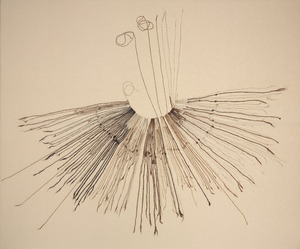
An Inca quipu, from the Larco Museum in Lima, Peru.
|
|
| Time period | c. 2600 BCE – c. 1900 CE |
| Note: This page may contain IPA phonetic symbols in Unicode. | |
A quipu (pronounced KEE-poo), sometimes spelled khipu, is an ancient tool used for keeping records. Instead of writing words on paper, people in South America tied knots into colorful cords. The word quipu comes from a Quechua word that means "knot." These tools were used across the high Andes mountains by different groups, especially during the powerful Inca Empire.
Contents
What Did a Quipu Look Like?
A quipu was usually made of spun cotton threads or animal wool. People often used soft hair from a llama or an alpaca. Some strands even used fibers from wild animals like the guanaco or vicuña.
A large quipu had one main cord hanging horizontally. Many smaller colored strings hung down from it like fringes. Some strings even had extra little cords attached to them. A small quipu had just a few cords, while larger ones had thousands. Different colors, fiber types, and cord directions held special clues about the message.
How the Incas Counted with Knots
The Incas were great organizers who used a math system based on tens, called a base-10 positional system. Clever experts called Leslie Leland Locke, Marcia Ascher, and Robert Ascher helped show how these numbers worked.
The Place-Value Secret

Each cluster of knots along a hanging string showed a digit. The position of the knot told the reader its place value:
- The lowest spot at the bottom of the string stood for the "ones" place.
- Moving higher up the cord showed the "tens" place.
- Higher still came the "hundreds" place, followed by the "thousands" place.
- To show the number zero, the maker simply left an empty space on the cord.
The Three Types of Knots
Inca record keepers used special knots to write different digits:
- Clusters of simple overhand knots showed digits of ten and higher.
- A special figure-eight knot was tied at the bottom to stand for the number one.
- A "long knot" with extra turns stood for numbers from two to nine. For example, four turns meant four.
The Quipu Masters and Their Jobs
Specially trained Inca officials were called quipucamayocs, which means "knot keepers." They were ancient accountants who performed math operations like arithmetic.
These experts tracked food stored in barns and collected taxes called mita. They counted all the people for a census and organized workers. Some historians believe quipus were also used like a writing system to record stories and songs, similar to music notation.
History and Modern Survival
The oldest known precursor may come from the ancient city of Caral, discovered by archaeologist Ruth Shady. Later, people of the Wari Empire made brightly colored cord systems.
When the Spanish Empire arrived in 1532, Spanish leaders often used quipus in legal courts to settle arguments. However, many quipus were burned during the Spanish era. Today, nearly 1,400 ancient quipus survive in collections like the Ethnological Museum of Berlin and museums in Lima, Peru. Modern Andean villagers still cherish quipus as sacred symbols of their ancestors' heritage.
Preserving Ancient Cord Records

Old quipus are very delicate. Museum experts work hard to protect them from heat, bugs, and damp air. Conservators store them flat on acid-free boards and protect them from ultraviolet light so their natural dyes do not fade away.
See also
 In Spanish: Quipu para niños
